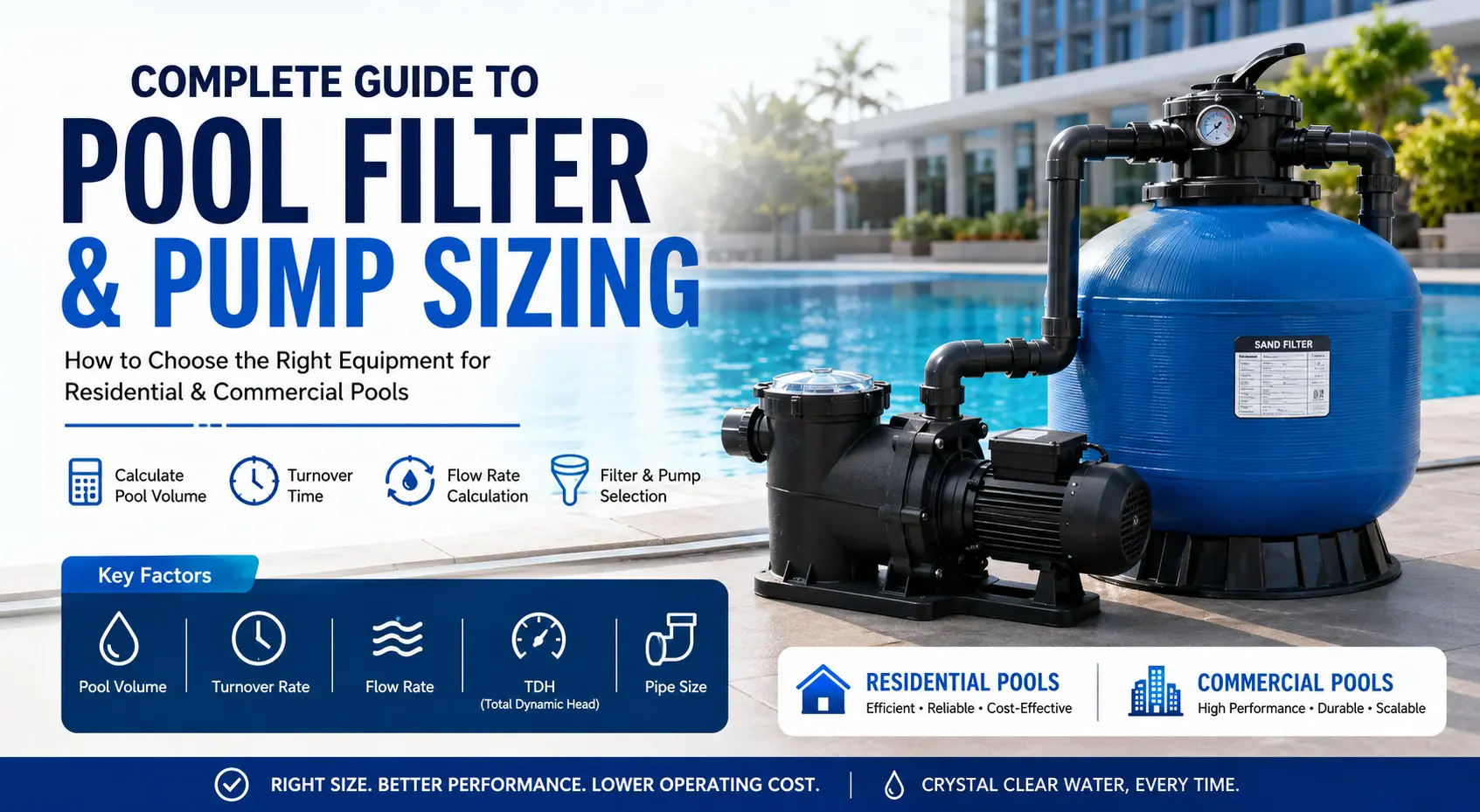
Complete Pool Filter & Pump Sizing Guide
A professional guide to calculating pool filter size, pump capacity, flow rate, turnover time, and equipment selection for residential and commercial swimming pools.

Learn how to calculate swimming pool filter size and pump capacity for residential and commercial pools using pool volume, turnover rate, flow rate, and equipment sizing formulas.
Why Correct Pool Equipment Sizing Matters
Filter & Pump Selection Guide
Selecting the correct swimming pool filter and pump ensures crystal-clear water, lower electricity costs, proper circulation, and longer equipment life.
Undersized equipment causes poor filtration, while oversized pumps waste electricity and may damage plumbing over time.
Professional sizing is based on pool volume, turnover time, required flow rate, Total Dynamic Head (TDH), and hydraulic design.
- Longer equipment life
- Lower operating cost
- Better water quality
- Improved energy efficiency
- Balanced hydraulic performance
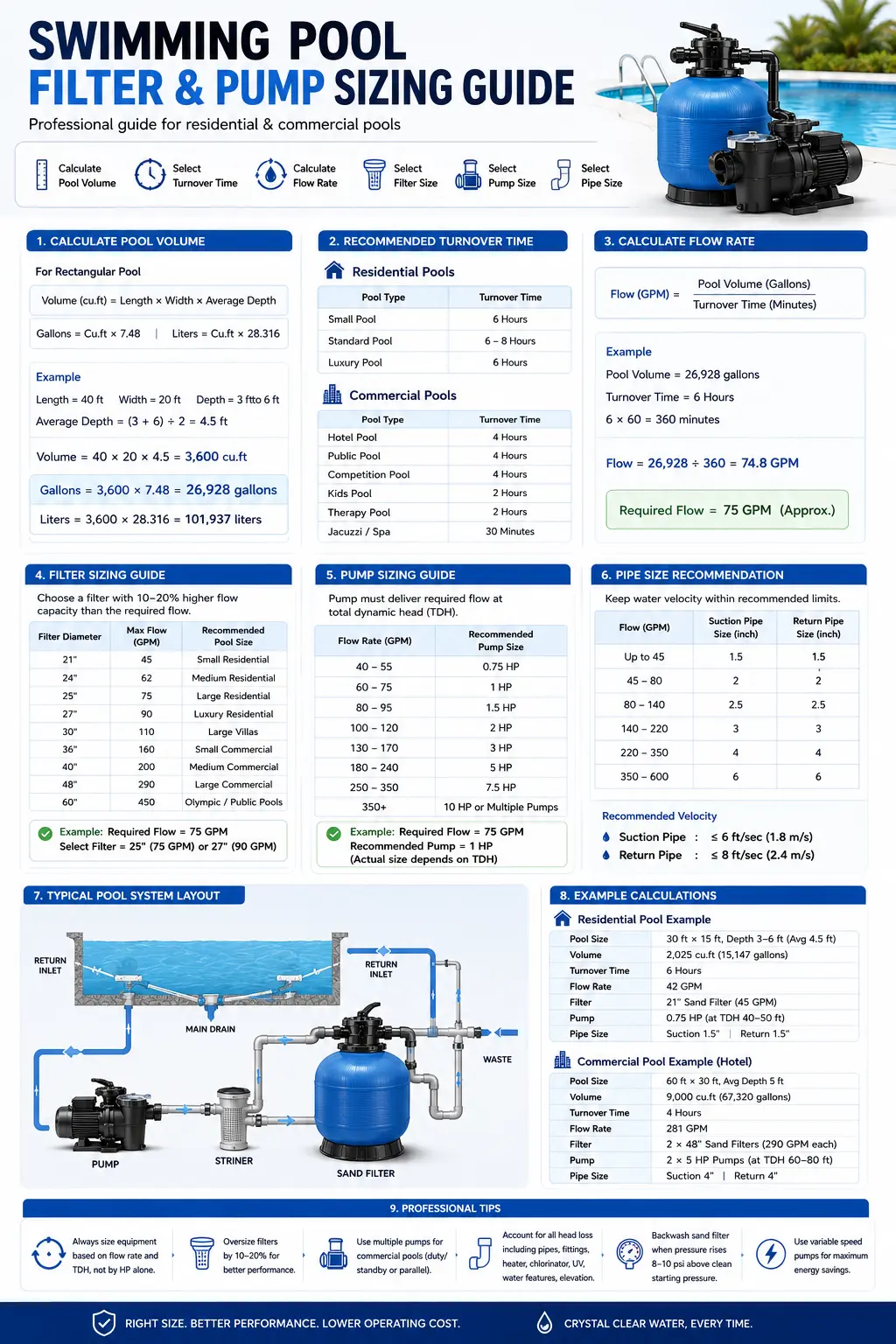
Step 1: Calculate Pool Volume
Pool volume is the starting point for selecting pumps and filters.
For rectangular pools, use Length × Width × Average Depth.
Average Depth = (Shallow Depth + Deep Depth) ÷ 2.
Pool Volume Formulas
| Calculation | Formula |
|---|---|
| Volume (Cubic Feet) | Length × Width × Average Depth |
| Gallons | Cubic Feet × 7.48 |
| Liters | Cubic Feet × 28.316 |
Step 2: Recommended Turnover Time
Turnover time is the number of hours required to circulate the entire pool volume once.
Turnover Standards
| Pool Type | Recommended Turnover |
|---|---|
| Residential Pool | 6 Hours |
| Villa Pool | 6 Hours |
| Hotel Pool | 4 Hours |
| Public Pool | 4 Hours |
| Competition Pool | 4 Hours |
| Children Pool | 2 Hours |
| Therapy Pool | 2 Hours |
| Spa / Jacuzzi | 30 Minutes |
Step 3: Calculate Flow Rate
Flow rate determines how much water the pump and filter must circulate.
Flow (GPM) = Pool Volume (Gallons) ÷ Turnover Time (Minutes).
- Convert hours into minutes.
- Always size equipment using calculated flow.
- Commercial pools require higher flow rates.
Pool Filter Sizing Guide
Always choose a filter with 10–20% higher flow capacity than the required flow rate.
Sand Filter Capacity
| Filter Diameter | Maximum Flow (GPM) | Recommended Pool Size |
|---|---|---|
| 21 Inch | 45 | Small Residential |
| 24 Inch | 62 | Medium Residential |
| 25 Inch | 75 | Large Residential |
| 27 Inch | 90 | Luxury Residential |
| 30 Inch | 110 | Large Villas |
| 36 Inch | 160 | Small Commercial |
| 40 Inch | 200 | Medium Commercial |
| 48 Inch | 290 | Large Commercial |
| 60 Inch | 450 | Olympic / Public Pools |
Pool Pump Sizing Guide
Pump horsepower should always be selected according to required flow rate and Total Dynamic Head (TDH).
Recommended Pump Sizes
| Flow Rate (GPM) | Pump Size |
|---|---|
| 40-55 | 0.75 HP |
| 60-75 | 1 HP |
| 80-95 | 1.5 HP |
| 100-120 | 2 HP |
| 130-170 | 3 HP |
| 180-240 | 5 HP |
| 250-350 | 7.5 HP |
| 350+ | 10 HP or Multiple Pumps |
Recommended Pipe Sizes
Pipe diameter directly affects pump performance and head loss.
Pipe Size Guide
| Flow (GPM) | Pipe Size |
|---|---|
| Up to 45 | 1.5 Inch |
| 45-80 | 2 Inch |
| 80-140 | 2.5 Inch |
| 140-220 | 3 Inch |
| 220-350 | 4 Inch |
| 350-600 | 6 Inch |
Commercial Pool Equipment Selection
Commercial pools should use multiple pumps and filters for redundancy and easier maintenance.
Duty and standby pump arrangements are recommended for hotels, schools, clubs, and public pools.
- Use multiple sand filters
- Provide standby pump
- Install balancing tank for overflow pools
- Use automatic chemical dosing
- Provide UV or ozone system where required
Residential & Commercial Examples
Residential Example: 30 × 15 × 4.5 ft pool = 15,147 gallons. Required flow = 42 GPM. Recommended equipment: 21-inch filter with 0.75 HP pump.
Commercial Example: 60 × 30 × 5 ft hotel pool = 67,320 gallons. Required flow = 281 GPM. Recommended equipment: Two 48-inch filters with two 5 HP pumps.
Professional Design Tips
Always verify pump performance using the manufacturer's performance curve.
Account for pipe length, fittings, heaters, chlorinators, UV systems, waterfalls, and elevation when calculating Total Dynamic Head.
- Never size pumps by horsepower alone.
- Keep suction velocity below 6 ft/sec.
- Keep return velocity below 8 ft/sec.
- Oversize filters by 10–20%.
- Backwash filters regularly.
- Use variable-speed pumps for energy savings.
Frequently Asked Questions
Find answers about swimming pool construction, maintenance, repair, renovation, filtration systems, chemical treatment and spa solutions in Karachi Pakistan.
Need Help Sizing Your Pool Equipment?
Pool Captain provides professional swimming pool design, hydraulic calculations, pump sizing, filter selection, plumbing design, and complete equipment supply for residential and commercial pools.